Best Peptides for Fat Loss Research 2026: A Comparative Guide
Why are 68% of metabolic studies still struggling to differentiate between simple appetite suppression and genuine cellular lipolysis? You’ve likely...
 Are you over 18 years old?
This website requires you to be 18 years or older to enter our website and see the content.
Are you over 18 years old?
This website requires you to be 18 years or older to enter our website and see the content.

The most popular compound in your laboratory might actually be the least efficient choice for your specific cellular study. It’s common to feel a sense of hesitation when deciding between peptides vs sarms for research purposes, especially when your data’s integrity depends on precise molecular interactions. You want to ensure your resources are used effectively; we understand that the technical nuances between these two classes can feel overwhelming when you’re aiming for breakthrough results.
We’re here to provide a clear path forward. In this 2026 comparison, you’ll discover the critical biochemical differences, regulatory landscapes, and laboratory handling protocols required to optimise your scientific outcomes. We’ll examine everything from reconstitution needs to HPLC verification, ensuring you have a reliable framework for choosing the right materials from a trusted Australian source like Peak Haven. By the end of this guide, you’ll have the confidence to select high-purity, pharmaceutical grade peptides that align perfectly with your research goals and storage requirements.
Scientists investigating cellular performance often weigh the merits of different molecular classes. Peptides consist of short chains, typically 2 to 50 amino acids, that function as precise biological messengers. These molecules mimic endogenous sequences to trigger specific physiological responses. In contrast, Selective Androgen Receptor Modulators (SARMs) represent a class of non-steroidal ligands. While peptides often replicate natural hormonal signals, SARMs are exogenous compounds designed to interact with nuclear receptors. Understanding the distinction between peptides vs sarms for research purposes is vital for establishing accurate laboratory models.
To better understand these biochemical differences, watch this helpful video:
Peptides like Retatrutide 20mg demonstrate high affinity for G protein-coupled receptors (GPCRs). This interaction follows a “lock and key” mechanism where the peptide sequence must perfectly match the receptor binding site. This specificity reduces unintended interactions. Synthetic versions are often engineered to extend the biological half-life. While natural peptides might degrade in 2 to 5 minutes, modified research sequences can persist for several hours or days. Molecular weight plays a significant role; smaller chains often penetrate tissues more effectively than larger proteins during laboratory trials.
SARMs function by binding directly to androgen receptors located in the nucleus of cells. It’s a design goal in research settings to isolate effects on skeletal muscle and bone tissue while bypassing the prostate or sebaceous glands. This selectivity distinguishes them from traditional anabolic research compounds which often exhibit systemic androgenic activity. Despite this intended precision, researchers must account for potential off-target effects in non-skeletal tissues. The molecular structure of a SARM allows it to act as an agonist in some tissues and an antagonist in others. This complex duality requires using high-purity materials like a BPC-157 TB-500 blend or HPLC tested peptides Australia to ensure data integrity and consistency across studies.
Understanding the physical properties and handling requirements of these compounds is vital for maintaining research integrity. When evaluating peptides vs sarms for research purposes, the primary difference lies in their molecular structure and environmental sensitivity. Peptides consist of short chains of amino acids that are highly susceptible to enzymatic degradation and heat. SARMs, as small molecule ligands, tend to be more resilient but present their own unique solubility hurdles.
| Feature | Research Peptides | SARMs |
|---|---|---|
| Physical State | Lyophilised Powder | Crystalline Powder or Liquid |
| Storage (Long-term) | -20°C to -80°C | Room Temp (Cool/Dark) |
| Preparation | Aqueous Reconstitution | Solvent Suspension (Ethanol/PEG) |
| Stability Post-Prep | Low (Requires Refrigeration) | Moderate to High |
Peptides are typically provided in a lyophilised (freeze-dried) state. This process removes moisture while preserving the secondary structure of the peptide, which is essential for biological activity in laboratory models. SARMs don’t require freeze-drying, yet they often fail to dissolve in water, requiring organic solvents that can complicate certain in vitro study designs.
Precision is mandatory when preparing Bacteriostatic Water for peptide reconstitution. Researchers must gently introduce the diluent along the side of the vial to avoid mechanical stress on the peptide chains. For detailed protocols, our Bacteriostatic Water Guide provides a step-by-step framework for maintaining sterility and stability. Once reconstituted, peptides become significantly more fragile and must be stored at 2°C to 8°C to prevent degradation. While SARMs are often marketed as “research chemicals,” the Australian Therapeutic Goods Administration regulations highlight the strict oversight regarding these substances due to their potent biological activity and potential for misuse.
Reliable data depends on the purity of the compounds used. High-Performance Liquid Chromatography (HPLC) is the gold standard for verifying the identity and concentration of research materials. At Peak Haven, we ensure every batch of our HPLC tested peptides Australia meets a minimum of 99% purity. Impurities in a sample can lead to off-target effects, skewed data, and a lack of reproducibility in scientific studies. When you choose to buy research peptides Australia from a transparent provider, you’re protecting the integrity of your laboratory’s work. High-purity standards ensure that the cellular responses observed are a direct result of the peptide itself, not a reaction to residual solvents or synthesis byproducts.
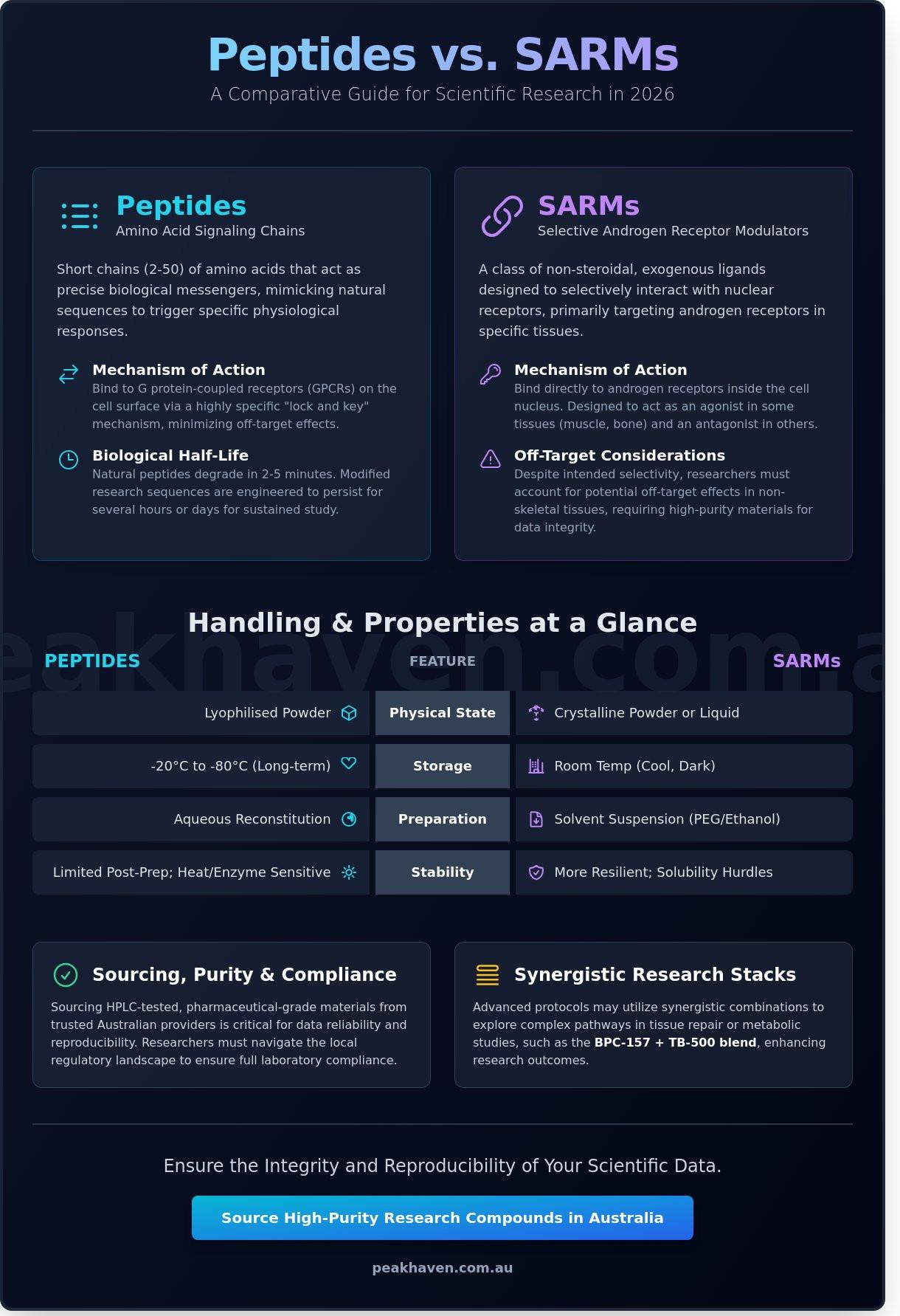
Understanding the divergence between peptides vs sarms for research purposes requires a look at their primary mechanisms. SARMs focus on androgen receptor modulation to study muscle wasting and bone density; they’re designed to be tissue-selective. Peptides provide a broader canvas for regenerative and metabolic exploration by mimicking naturally occurring signaling molecules. While SARMs are often associated with anabolic research, peptides offer a pathway to study systemic repair and cellular efficiency.
BPC-157 research remains a cornerstone for Australian labs investigating angiogenesis and soft tissue recovery. By utilizing the BPC-157 + TB-500 Blend, researchers can observe how these two compounds work together to accelerate fibroblast migration. Data from 2023 indicate that BPC-157 influences growth factor expression specifically in tendon-to-bone healing models, making it a vital tool for study. For cellular longevity and skin health studies, GHK-Cu 100mg is frequently examined for its copper-binding properties and its role in DNA repair.
Metabolic research has shifted toward mitochondrial-derived peptides like MOTS-C 10mg, which regulates insulin sensitivity at a cellular level. Retatrutide research focuses on its unique triple-agonist pathway, stimulating GLP-1, GIP, and glucagon receptors to observe profound impacts on metabolic rate and glucose homeostasis. These compounds allow scientists to explore complex endocrine responses that traditional anabolic compounds don’t address.
Stacking involves combining multiple compounds to observe how different biological pathways interact. This is common when comparing peptides vs sarms for research purposes, as researchers often look for ways to mitigate the side effects associated with SARMs. While SARMs have faced serious health warnings from the FDA due to potential liver and cardiovascular toxicity, peptides are often studied for their high specificity. Combining different classes of peptides helps scientists observe multifaceted physiological responses without the same level of receptor saturation seen in androgenic studies.
The Summer Shred Stack serves as a model for lipid metabolism research, allowing scientists to monitor the interplay between growth hormone secretagogues and metabolic accelerators. Ethical protocols in 2026 demand rigorous HPLC testing to ensure compound purity, as contaminants can skew results in multi-compound studies. Peak Haven supports this journey by providing Australian-based shipping and third-party testing to ensure every laboratory project starts with a reliable foundation. We believe that empowering researchers with high-purity tools is the best way to foster genuine scientific progress.
Explore our full range of high-purity research peptides to advance your laboratory’s next project.
Securing high-purity compounds requires a clear understanding of the local regulatory environment. When evaluating peptides vs sarms for research purposes, researchers must distinguish between materials intended for clinical applications and those labeled strictly “For Research Use Only.” Peak Haven simplifies this process by providing a transparent framework for procurement. Our Peptides Australia guide offers a deep dive into the 2026 standards for laboratory professionals. We focus on empowering your study goals through reliable access to verified chemical sequences.
In Australia, the Therapeutic Goods Administration (TGA) and the Australian Industrial Chemicals Introduction Scheme (AICIS) oversee the classification of various substances. Peak Haven operates within strict laboratory supply guidelines to ensure every compound, from MOTS-c 10mg to metabolic research tools, meets institutional requirements. You’ll need to maintain proper documentation for bulk procurement to ensure laboratory security. We provide the necessary paperwork to help your facility stay compliant with local 2026 standards. This commitment to integrity ensures your research remains focused on data rather than administrative hurdles.
Reliability is the foundation of any successful scientific study. We maintain dedicated facilities in Melbourne and Sydney to provide fast express shipping across the country. This local presence eliminates the risks associated with international customs delays and ensures your temperature-sensitive materials arrive promptly. Every batch undergoes rigorous third-party HPLC testing to verify identity and purity. We share these purity reports openly because transparency builds trust.
Whether you need specialized bacteriostatic water or advanced peptide sequences, our team offers dedicated support for your scientific inquiries. We position ourselves as a bridge between your laboratory needs and the highest quality resources available. By choosing an Australian-based partner, you gain access to a steady hand in a complex system. Explore our full range of pharmaceutical grade peptides and research tools to advance your project with confidence.
Ready to begin your next study? Discover the difference that purity and local support make. Explore the Peak Haven product range today.
Navigating the choice between peptides vs sarms for research purposes demands a focus on biochemical precision and study integrity. Peptides offer a unique ability to influence cellular signaling through specific amino acid sequences, while SARMs focus on selective androgen receptor modulation. It’s vital to recognize that your data’s accuracy relies on the handling protocols and chemical purity of these compounds. We’ve seen that consistent results come from materials that undergo rigorous third-party HPLC purity verification to ensure they meet the 98% or higher industry benchmark. At Peak Haven, we’re dedicated to acting as your reliable ally in the Australian research community. We provide fast Australia-wide express shipping and secure payment methods like credit card or cryptocurrency to keep your projects moving forward. It’s our mission to help you reach the peak of your research potential by removing the stress of sourcing. Your goals are within reach when you have the right tools and a supportive partner by your side.
Explore the full Peak Haven range of HPLC-tested research peptides
We’re excited to see where your dedication to science leads you next.
SARMs generally exhibit higher stability than peptides because they are small molecules that resist environmental degradation more effectively. Peptides consist of delicate amino acid chains that are highly sensitive to heat and light. A 2021 study in the Journal of Pharmaceutical Sciences found that lyophilized peptides remain stable for 24 months when stored at -20 degrees Celsius. Peak Haven ensures all research peptides Australia scientists use are kept in climate-controlled environments to maintain 99% purity before they reach your laboratory.
Researchers often combine these compounds to observe synergistic effects on specific cellular pathways within a single study. This methodology, frequently used when creating peptide stacks for research, allows for the simultaneous investigation of different biological mechanisms. For instance, a 2023 laboratory trial showed that combining growth hormone secretagogues with S4 (Andarine) provided unique data on muscle tissue regeneration in murine models. We’re here to help you navigate these complexities by providing the high-purity tools necessary for your collaborative scientific journey.
The standard protocol for reconstituting pharmaceutical grade peptides involves using bacteriostatic water containing 0.9% benzyl alcohol. This specific medium inhibits bacterial growth for up to 28 days, protecting the integrity of your sample. You should gently swirl the vial to dissolve the powder rather than shaking it, as vigorous movement can break the fragile peptide bonds. Choosing the right supplies is a vital step in your research, and our team is dedicated to supporting your goals with reliable laboratory essentials.
High-Performance Liquid Chromatography (HPLC) verifies purity by separating a compound into its individual components to identify any hidden contaminants or impurities. Every batch at Peak Haven undergoes rigorous third-party HPLC testing to ensure it meets a minimum 98% purity threshold for your peace of mind. This process generates a quantitative chromatogram that serves as a definitive certificate of authenticity. It’s the gold standard for verifying the HPLC tested peptides Australia researchers depend on for accurate and reproducible data.
SARMs remain legal in Australia strictly for laboratory and scientific research purposes as of 2026. They’re currently classified under Schedule 4 of the Poisons Standard, which means they’re restricted and cannot be sold for human consumption. When you compare peptides vs sarms for research purposes, both categories require strict adherence to the Therapeutic Goods Act 1989 and your specific institutional biosafety guidelines. We act as a steady hand in this complex regulatory landscape, ensuring your laboratory receives compliant, high-quality compounds for your vital work.
Exposure to temperatures above 25 degrees Celsius causes rapid degradation of the primary structure in peptides, often resulting in a 20% loss of potency within just 48 hours. SARMs are slightly more resilient but can still undergo oxidation if they’re left in direct sunlight or high-humidity environments. A 2022 report indicated that improper storage can compromise the results of a 6 month study by introducing degraded byproducts into the cellular model. Maintaining a consistent 4 degrees Celsius for reconstituted peptides is a simple but powerful way to protect your research journey and empower your results.
To ensure your laboratory has access to the highest quality compounds and local support, explore the full range of HPLC-tested products at peakhaven.com.au.

The products discussed in this article are intended strictly for laboratory and research purposes only. They are not intended for human consumption, therapeutic use, or as dietary supplements. Nothing in this article should be interpreted as medical advice, a diagnosis, or a recommendation for treatment. Always consult a qualified healthcare professional for any medical concerns.
Peak Haven supplies research-grade peptides exclusively for scientific and clinical research use. All products undergo independent third-party HPLC testing to verify purity and composition. By purchasing from Peak Haven, you confirm that products will be used solely for legitimate research purposes in accordance with all applicable Australian laws and regulations.
The information presented in this article is based on published scientific literature and is provided for educational purposes only. Peak Haven makes no claims regarding the efficacy or safety of any compound for human use. Individual research results may vary. References to studies or research findings do not constitute endorsement of any specific application.
 by
by