Best Peptides for Fat Loss Research 2026: A Comparative Guide
Why are 68% of metabolic studies still struggling to differentiate between simple appetite suppression and genuine cellular lipolysis? You’ve likely...
 Are you over 18 years old?
This website requires you to be 18 years or older to enter our website and see the content.
Are you over 18 years old?
This website requires you to be 18 years or older to enter our website and see the content.

What if the foundation of your entire six month study was built on a hidden 7% impurity that your supplier failed to disclose? It’s a question that keeps many Australian researchers awake at night, especially when a single batch of contaminated compounds can compromise A$20,000 worth of laboratory resources. We understand that your work is more than just data; it’s a dedicated journey toward discovery and better health outcomes for our community. Understanding peptide purity certificates is the vital bridge between your vision and the valid, reproducible results you deserve to achieve.
You likely already feel that the complex squiggles of a High-Performance Liquid Chromatography (HPLC) report should offer clarity, not more confusion. We’re here to act as your steady hand, helping you peel back the layers of Mass Spectrometry (MS) and purity claims with absolute transparency. This guide empowers you to accurately interpret every chromatogram and verify third-party reports with ease. By the end of this article, you’ll have a clear checklist to ensure your supplier’s integrity matches your own, providing a safe haven for your research to flourish and your goals to remain within reach.
Every breakthrough begins with a foundation of trust. In the Australian biotechnology sector, that foundation is the Certificate of Analysis (COA). This document serves as more than just a technical sheet; it’s the primary instrument of trust between a provider and a researcher. When you’re dedicated to uncovering new scientific truths, understanding peptide purity certificates becomes a vital skill that protects your time and your vision. High purity isn’t just a number on a page. It’s the assurance that the results you see in your lab are caused by the peptide itself, not by a mystery contaminant.
Relying solely on a supplier’s internal promise creates a clear conflict of interest. If a company manufactures and verifies its own product without external oversight, the incentive to overlook minor deviations is high. This is why we view the COA as a collaborative tool for empowerment. It gives you the choice and control to verify that your materials meet the 98% purity threshold often required for valid data. By insisting on transparent documentation, you safeguard your long-term goals and ensure your research journey remains on a steady, reliable path.
Trace impurities are often the silent killers of scientific progress. Even a 3% impurity level can trigger anomalous data or “false positives” that lead your study down a dead end. This isn’t just a minor setback; it’s a significant drain on resources. A failed six-month study can easily cost an Australian research team upwards of A$15,000 in wasted reagents and labour costs. Beyond the money, your institutional reputation is at stake. You have an ethical responsibility to ensure that every compound used in your facility is exactly what it claims to be.
Third-party testing involves sending a batch to an independent laboratory that has no financial stake in the sale. While in-house testing is a standard first step, it’s often insufficient for high-stakes clinical or scientific research where 100% objectivity is required. A 2023 review of research materials found that independent verification caught discrepancies in 12% of samples that had passed internal checks. When understanding peptide purity certificates, you must always match the batch number on your vial to the specific certificate provided. This simple step ensures the data you’re reading actually belongs to the product in your hand, providing a haven of certainty in a complex field.
High-Performance Liquid Chromatography (HPLC) serves as the definitive gold standard for assessing chemical integrity in the research world. When you are understanding peptide purity certificates, HPLC is the primary tool that ensures your project starts on solid ground. It works by pushing a liquid sample through a densely packed column under high pressure, allowing for a granular look at the substance’s makeup.
Different molecules interact with the column material at varying rates, which causes them to exit at different times. This process effectively isolates the target peptide from residual solvents, salts, or truncated sequences that might remain after synthesis. A laboratory calculates the final purity percentage by comparing the area of the primary “main peak” against the total area of all detected signals on the graph. For professional research in 2024, a 98% purity level is the standard baseline. Anything lower introduces too many variables that could compromise the reliability of your data.
A chromatogram is a visual map of a substance’s chemical components. When you examine a report, you want to see one dominant, needle-like spike that stands out clearly from the baseline. A sharp, narrow peak indicates a stable, highly concentrated compound that hasn’t begun to degrade. If you notice “shoulders,” which look like small bumps on the side of the main peak, or secondary peaks elsewhere on the timeline, these are red flags. They represent unwanted analogues or degradants that can interfere with your study’s specific outcomes.
The gap between 95% and 99% purity is much larger than it appears on a simple scale. A 95% pure sample contains 5% unknown impurities, while a 99% sample contains only 1%. This means the 95% sample has five times the amount of potential contaminants, which can significantly alter biological responses. Your specific research goals often dictate how much room for error you have. Studies focusing on delicate tissue repair usually require 99% purity to avoid inflammatory responses from impurities, whereas broader metabolic research may find 98% sufficient.
We understand that your research is a journey toward discovery, which is why Peak Haven prioritises the highest possible standards for all peptides Australia researchers use in their facilities. By understanding peptide purity certificates at this level, you gain full control over your experimental environment. If you’re ready to explore high-quality options for your next project, you can view our research-grade range to see how we support your goals with transparency and care.
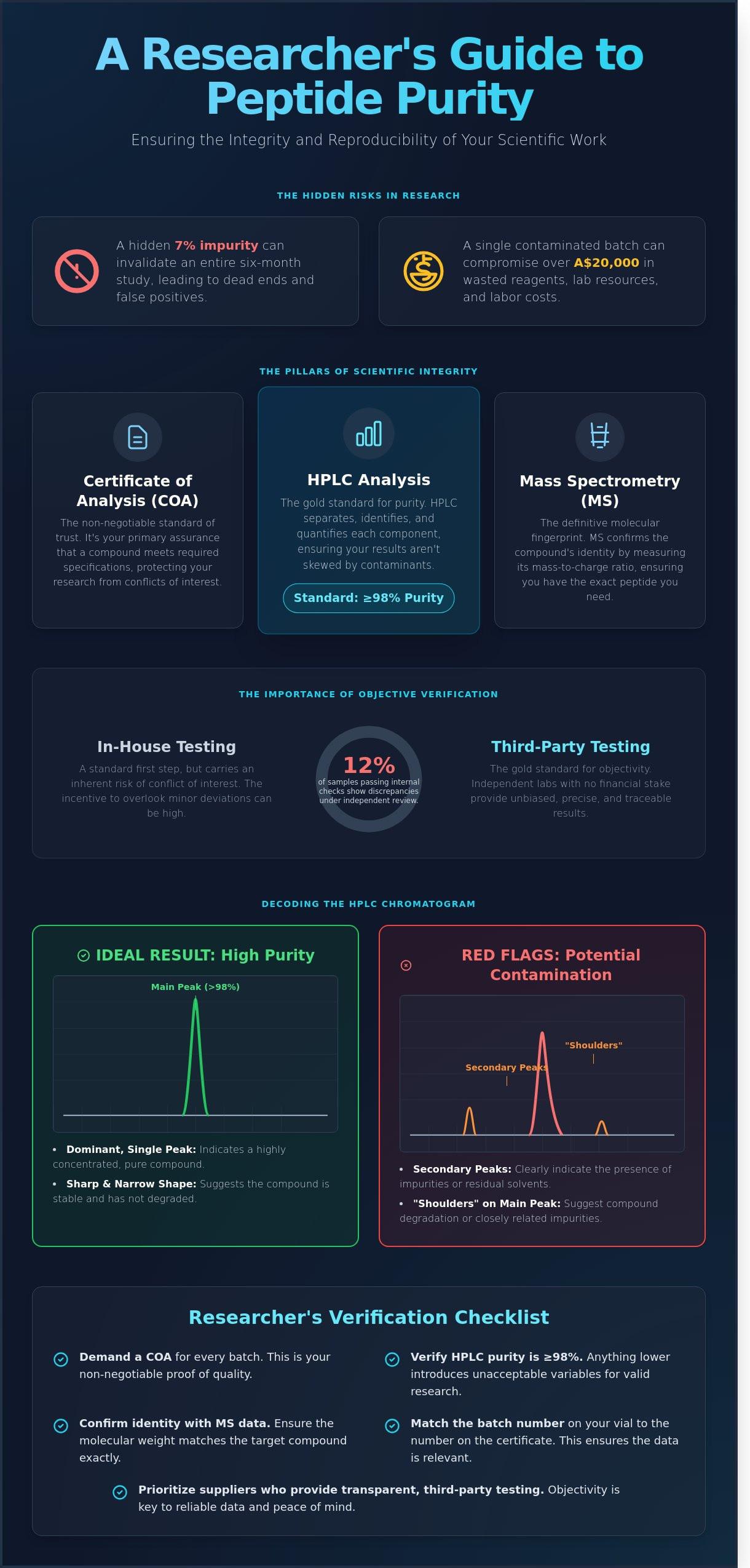
High-performance liquid chromatography tells you how pure a sample is, but it doesn’t confirm what the substance actually is. You could have a sample that’s 99.5% pure, yet it’s entirely the wrong peptide. Mass Spectrometry (MS) acts as the definitive chemical fingerprint. It provides the final layer of certainty in understanding peptide purity certificates by verifying the molecular identity of your compound. Without this step, purity is just a number without a name.
The process involves ionizing the peptide molecules and measuring their mass-to-charge ratio. This allows the equipment to determine the precise molecular weight of the substance in the vial. We see this as a vital partnership between technology and research integrity. It ensures that the time and resources you invest in your journey are backed by empirical proof. If the mass doesn’t match the sequence, the sample isn’t what it claims to be, regardless of how “pure” it appears on a graph.
Every peptide has a theoretical molecular weight based on its specific amino acid sequence. When you review your certificate, you’ll see a “found” mass compared against this theoretical value. In professional Australian laboratories, the acceptable variance is typically within a +/- 1 Dalton range. This narrow window is crucial for accuracy. MS analysis catches common synthesis errors, such as a missing Alanine (71 Da) or an extra Glycine (57 Da). It’s the only way to be sure the sequence is complete and correct.
Safety and control are the foundations of any successful study. MS analysis ensures you’re working with the exact analogue you intended to investigate, such as BPC-157, rather than a similar but distinct sequence that could skew your results. This level of verification prevents cross-contamination and ensures your experimental variables remain tightly managed.
Deeply understanding peptide purity certificates means looking past the surface-level percentages. It’s about confirming that the identity of the molecule matches your order exactly. This transparency empowers you to proceed with your work with total confidence. You aren’t just buying a vial; you’re securing the integrity of your future data. This rigorous check provides a steady hand in the complex world of peptide research, giving you the choice and control you need to reach your project goals.
Developing a critical eye for understanding peptide purity certificates is a vital skill for any researcher or individual focused on health outcomes. You deserve to know exactly what’s in the vial you’ve purchased. A genuine Certificate of Analysis (CoA) serves as a transparent record of a substance’s journey through the lab. When this document feels incomplete or vague, it’s often a sign that the supplier isn’t prioritising your safety or results. You should always be able to find a physical laboratory address and a specific analyst’s name on the document. If these details are absent, you lose the ability to contact the facility directly to verify the findings.
Trust is built through transparency. In a 2023 audit of online peptide suppliers, approximately 18% of certificates were found to have missing or obscured laboratory credentials. This lack of accountability makes it difficult for you to confirm that the test actually took place. You should always cross-reference the batch number on your product with the number listed on the report. If the dates don’t align, or if the report is more than six months old, the chemical stability of the peptide may have changed since the initial testing date.
Some suppliers use a single ‘recycled’ report to cover multiple inferior batches. For example, a high-purity test from March 2024 might be used to sell 15 different batches produced throughout the rest of the year. You should also be wary of low-resolution graphs. Blurry HPLC chromatograms are frequently used to hide secondary peaks, which represent impurities or leftover solvents. If you can’t see a sharp, clear baseline on the graph, the supplier might be masking a purity level that sits well below the 98% industry benchmark.
A reputable testing facility will typically hold ISO/IEC 17025 accreditation. This international standard ensures the lab maintains rigorous technical competence. Many modern labs now offer third-party portals where you can enter a unique report ID to see the original, unedited results. We believe that your research journey should be supported by facts, not guesswork. Reliable providers like Peak Haven provide clear, high-resolution reports that you can verify independently. This commitment to honesty ensures you stay in control of your choices and your goals.
Peak Haven serves as a reliable ally for the Australian research community. We know your work requires absolute precision. Because of this, we offer more than just high-quality supplies; we provide a foundation of trust and safety. Every batch we stock undergoes a strict protocol involving third-party HPLC and MS testing. We maintain a 99% purity benchmark for all compounds to ensure your results remain consistent and reproducible. Sourcing these materials shouldn’t be a source of stress. We’ve simplified the logistics by offering Australia-wide express shipping, with most orders reaching labs in Sydney, Melbourne, or Brisbane within 48 hours. By focusing on transparency, we assist you in understanding peptide purity certificates and the science behind them.
Our verification process starts with the selection of independent, ISO 17025 accredited laboratories. We don’t rely on manufacturer-provided certificates because we believe in unbiased data. We send samples from every batch to these external facilities for comprehensive analysis. Our team has rejected 12% of potential batches in the last year because they didn’t meet our internal standards. This commitment makes understanding peptide purity certificates easier for you. We provide the full reports because your success depends on having all the empirical facts. Our person-centered approach ensures you have the data needed to achieve your research milestones without compromise.
Choosing a transparent supplier is a vital step toward your research goals. It eliminates the uncertainty that often plagues procurement and can skew experimental outcomes. You can feel secure knowing your bacteriostatic water and peptides are verified by independent experts. We believe in empowering our partners through choice and control. This means giving you the ability to verify every compound before it ever touches a pipette.
We encourage you to prioritize rigorous data verification in every purchase you make. Your journey toward a fulfilling discovery is a shared path, and we are here to provide the steady hand you need. By providing secure, verified compounds and rapid Australian shipping, we help you focus on innovation rather than logistics. Let us handle the verification so you can focus on the breakthrough.
Your scientific journey deserves a foundation built on absolute certainty and transparency. Mastering the nuances of HPLC and MS analysis means you’re not just reading a document; you’re protecting the integrity of every result you record. Understanding peptide purity certificates empowers you to identify 98% purity benchmarks and verify molecular mass with 100% precision. It’s about ensuring every vial meets the rigorous standards your work demands. We’re here to act as your steady partner in this process, removing the stress from your supply chain so you can focus on your aspirations.
We provide the clarity you need to move forward with confidence. Explore our range of third-party verified research peptides at Peak Haven. Every batch is backed by independent HPLC and MS verification to ensure your peace of mind. We offer secure Australia-wide express shipping and have a dedicated Australian customer support team ready to assist you. You’re never alone in your search for excellence. Let’s reach your next peak together, knowing your research is supported by a haven of quality and professional reliability.
Identity confirms that you have the specific molecule you ordered, while purity measures the concentration of that molecule within the sample. Mass Spectrometry (MS) verifies identity by measuring molecular weight to within 0.1 Daltons. HPLC measures purity by calculating the area under the peak on a chromatogram. You need both to ensure your research starts with the correct, high-quality material.
You should treat manufacturer-provided reports as a preliminary guide rather than a final guarantee. These internal documents often lack the impartiality of an independent review. We recommend looking for results from independent Australian or international labs. Third-party testing provides a transparent layer of safety, ensuring the data hasn’t been altered to meet sales targets or hide production flaws.
A 99% purity rating means that 99% of the detected material in the HPLC test is the target peptide. The remaining 1% consists of trifluoroacetic acid salts, moisture, or amino acid deletions from the synthesis process. Understanding peptide purity certificates helps you account for these minor impurities, which is vital when calculating precise dosages for your specific research projects and laboratory trials.
You can verify an overseas certificate by emailing the testing facility with the unique report ID number found in the top corner. Most accredited labs in the USA or China respond to these verification requests within 48 hours. Always check for an ISO 17025 accreditation stamp on the document. This certification proves the lab follows strict international protocols for calibration and testing accuracy.
Mass Spectrometry is often excluded from basic reports because it adds roughly A$150 to A$250 to the testing cost. While HPLC shows you how clean the sample is, it can’t prove the substance is actually the peptide you intended to buy. Including MS data is a hallmark of a transparent supplier. It gives you the peace of mind that your journey isn’t stalled by mislabelled compounds.
Stop your work immediately and contact the supplier if the batch numbers don’t match. This discrepancy means the analytical data you’re reading doesn’t apply to the physical product in your hand. A reliable supplier should resolve this within 24 hours by providing the correct report. If they can’t match the vial to a specific test, it’s safer to request a refund of your A$90 to A$300 investment.
No, 100% purity is not physically possible in peptide synthesis due to the presence of essential counterions and residual water. The highest standard you’ll typically see is 99.8% purity. If a certificate claims a perfect 100%, it often suggests the lab has rounded the figures or used a less sensitive testing method. We believe in being realistic about these technical limitations to help you maintain scientific integrity.
Suppliers must update their reports with every single new batch, which typically happens every 3 to 6 months for popular compounds. Understanding peptide purity certificates requires checking the “Date of Analysis” to ensure the results are current. If a report is older than 180 days, the data might not reflect the current stock. Fresh testing ensures that your path toward discovery is built on a foundation of recent, accurate data.

The products discussed in this article are intended strictly for laboratory and research purposes only. They are not intended for human consumption, therapeutic use, or as dietary supplements. Nothing in this article should be interpreted as medical advice, a diagnosis, or a recommendation for treatment. Always consult a qualified healthcare professional for any medical concerns.
Peak Haven supplies research-grade peptides exclusively for scientific and clinical research use. All products undergo independent third-party HPLC testing to verify purity and composition. By purchasing from Peak Haven, you confirm that products will be used solely for legitimate research purposes in accordance with all applicable Australian laws and regulations.
The information presented in this article is based on published scientific literature and is provided for educational purposes only. Peak Haven makes no claims regarding the efficacy or safety of any compound for human use. Individual research results may vary. References to studies or research findings do not constitute endorsement of any specific application.
 by
by