Best Peptides for Fat Loss Research 2026: A Comparative Guide
Why are 68% of metabolic studies still struggling to differentiate between simple appetite suppression and genuine cellular lipolysis? You’ve likely...
 Are you over 18 years old?
This website requires you to be 18 years or older to enter our website and see the content.
Are you over 18 years old?
This website requires you to be 18 years or older to enter our website and see the content.

Did you know that in 2024, over 1,073,329 horseshoe crabs were harvested for endotoxin testing, yet many Australian labs still face the nightmare of non-replicable data? You’ve likely felt the frustration of seeing unexplained cytokine activation in your control groups, wondering where your protocol went wrong. The truth is that the impact of endotoxins on immunology research outcomes is often a silent variable that can compromise even the most carefully designed study. It’s an exhausting drain on your research budget and, more importantly, your time.
We understand that your goal is to produce reliable, high-quality science that stands up to peer review. This guide provides a clear path forward, detailing the March 2026 FDA updates on risk-based endotoxin control and the global shift toward animal-free testing standards like USP Chapter <86>. You’ll learn how to source pharmaceutical grade peptides and why third-party HPLC purity testing is your best defense against contamination. By choosing Peak Haven for your research peptides Australia, you’re partnering with a team dedicated to your laboratory’s success and the integrity of your data. Let’s explore how to keep your research robust and your outcomes replicable.
To understand the impact of endotoxins on immunology research outcomes, we must first look at their biological origin. Endotoxins, also known as What are Endotoxins (LPS), are large molecules found in the outer membrane of Gram-negative bacteria like E. coli. They aren’t secreted by living bacteria; instead, they’re released when the bacterial cell wall disintegrates. This makes them a persistent presence in any environment where bacteria have ever existed, including high-tech laboratory settings. In your journey to uncover scientific truths, these molecules often act as “ghost variables,” triggering cellular responses that you didn’t intend to measure.
Because endotoxins are exceptionally potent, even picogram levels can skew your data. For instance, the March 2026 FDA guidance highlights that thresholds as low as 0.5 EU/ml are critical for cardiovascular safety, yet in an in vitro setting, much smaller amounts can cause macrophages to release inflammatory markers. This creates a confounding variable that makes it nearly impossible to tell if your research peptide caused the reaction or if a microscopic contaminant is to blame. When your control group shows unexplained cytokine activation, endotoxin interference is the most likely culprit.
To better understand this concept, watch this helpful video:
LPS is notoriously resilient. It’s highly heat-stable, meaning standard laboratory sterilization won’t help you here. While a typical autoclave cycle at 121°C kills live bacteria, it doesn’t deactivate the endotoxins they leave behind. True depyrogenation requires dry heat at 250°C for at least 30 minutes. We measure these contaminants in Endotoxin Units (EU) per millilitre. Because the potency of LPS varies between bacterial strains, using EU/ml provides a standardised way for you to report and compare the impact of endotoxins on immunology research outcomes across different studies.
Contamination can enter your workflow through several common vectors. Reagents, plasticware, and even the air in your facility can carry LPS. However, water is the most frequent source of trouble. Using high-purity bacteriostatic water for your reconstitutions is a vital step in protecting your research integrity. By following a dedicated Bacteriostatic Water Guide, you can ensure that your handling techniques don’t inadvertently introduce variables that could compromise your published results.
The impact of endotoxins on immunology research outcomes is most visible at the receptor level. When lipopolysaccharides (LPS) enter your assay, they immediately bind to Toll-like Receptor 4 (TLR4). This interaction isn’t subtle; it triggers a cascade of intracellular signalling that leads to the “cytokine storm” effect. Your macrophages and monocytes begin producing unintended levels of TNF-alpha and IL-6, creating a high-energy background noise. This noise doesn’t just complicate your data; it can completely mask the subtle metabolic or hormonal shifts you’re trying to observe when studying compounds like Retatrutide 20mg.
Beyond cytokine production, endotoxins fundamentally alter cell viability and morphology. In primary cell cultures, LPS exposure can lead to premature cell death or force cells into a pro-inflammatory phenotype that doesn’t reflect a healthy baseline. If you’re looking to maintain the highest standards in your lab, you can browse our range of HPLC tested research peptides to ensure your starting materials aren’t introducing these unwanted variables.
One of the most complex challenges in long-term studies is the phenomenon of innate immune programming by endotoxin. This involves two opposing states: “trained immunity,” where cells remain in a heightened state of alert after LPS exposure, and “endotoxin tolerance,” where cells become hypo-responsive to further stimuli. Both states lead to non-replicable data because the cells’ “memory” of the contaminant changes how they respond to your actual research variables over time. It’s a silent shift that can ruin months of longitudinal research.
In tissue repair studies involving compounds like BPC-157, LPS-induced inflammation acts as a significant counter-signal. Instead of measuring the peptide’s regenerative potential, you might end up measuring its ability to mitigate the contamination you unknowingly introduced. This often leads to false-positive results in anti-inflammatory testing, where the compound appears more “effective” simply because it’s fighting off the endotoxins in the vial. Endotoxins alter the baseline activation state of macrophages in laboratory models, essentially rewriting the cellular starting point before your research even begins.
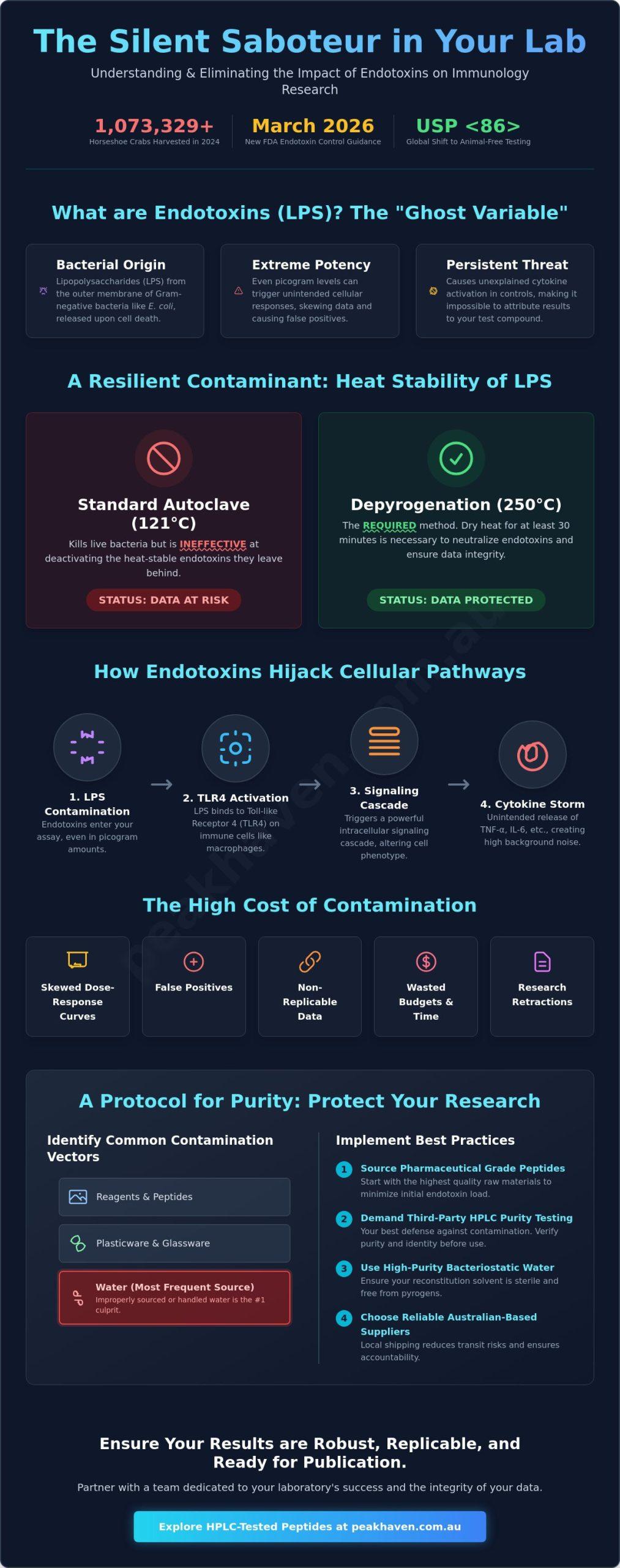
The professional and financial cost of non-replicable data is a heavy burden for any laboratory. When lipopolysaccharides skew your dose-response curves, they create a false narrative about a compound’s efficacy. You might observe a significant biological response at a low concentration, only to realise later that the response was triggered by endotoxins rather than your actual test subject. This often leads to the misidentification of a compound’s mechanism of action. As high-impact journals increasingly align with the March 2026 FDA risk-based lifecycle approach, the impact of endotoxins on immunology research outcomes has become a primary focal point for peer reviewers. Publishing results that cannot be replicated by others doesn’t just waste your research budget; it can stall your career and damage the integrity of your entire field.
Endotoxins introduce a level of statistical noise that can drown out your actual findings. Because contamination isn’t always uniform, it creates an “n=1” problem where specific wells or batches behave differently from the rest of your set. This inconsistency reduces the statistical power of your experiment, making it harder to achieve significant p-values. You should look for outliers in your control groups as a potential signal of endotoxin presence. If your untreated cells are showing activation levels similar to your treated groups, it’s time to audit your reagents for hidden impurities.
To protect your work, third-party HPLC tested peptides Australia are essential. While HPLC confirms the chemical purity and identity of your peptide, it identifies chemical byproducts rather than biological contaminants like LPS. That’s why we at Peak Haven ensure our products are verified for high-purity laboratory use, pairing rigorous testing with the reliability of Australian-based shipping. This dual approach helps you avoid the degradation risks and contamination often found in international transit. You can ensure your next study is built on a foundation of truth by choosing pharmaceutical grade peptides from a trusted local source.
Protecting your data starts long before you reach for a pipette. It begins with your procurement strategy. We understand that the pressure to produce high-impact results is immense, and you shouldn’t have to worry about whether your starting materials are working against you. Given the significant impact of endotoxins on immunology research outcomes, your choice of supplier is perhaps the most critical variable in your experimental design. Establishing a rigorous audit protocol for your reagents ensures that you aren’t unknowingly introducing Lipopolysaccharides (LPS) into your cellular models.
Choosing Australian-based suppliers offers a distinct advantage for local labs. International shipping often involves long transit times and unpredictable customs delays, which can expose sensitive research compounds to temperature fluctuations. These conditions can compromise the integrity of the vial’s seal or lead to the degradation of the peptide itself. By opting for local, express shipping, you minimize these risks and maintain a tighter “sterile chain” from the manufacturer to your lab bench. When you buy research peptides Australia, you’re not just saving time; you’re securing the reliability of your baseline data.
To ensure your laboratory stays ahead of the March 2026 FDA risk-based guidelines, use this checklist for every new batch of materials:
The quality of your published results is directly tied to the purity of your inputs. In a landscape where replicability is the gold standard, there’s no room for the silent interference of bacterial contaminants. We’re here to act as your steady partner in this complex system, providing the high-purity tools you need to achieve your research goals with confidence. For a broader look at the current landscape, we invite you to explore our Peptides Australia 2026 Guide. When you’re ready to start your next study, explore the Peak Haven range of HPLC-tested research peptides and ensure your scientific legacy is built on a foundation of truth.
Your commitment to scientific discovery deserves a foundation of absolute purity. We’ve explored how the impact of endotoxins on immunology research outcomes can lead to non-replicable data and professional setbacks. By understanding the biological mechanisms of LPS interference and implementing a rigorous procurement checklist, you’re taking a vital step toward safeguarding your results. You have the agency to eliminate these silent variables through careful sourcing and sterile handling protocols.
At Peak Haven, we’re here to act as your steady partner in the laboratory. We ensure every batch of our strictly laboratory-grade research compounds undergoes third-party HPLC purity verification, giving you the transparency you need for high-impact publishing. Our commitment to your success includes Australia-wide express shipping, which protects your sensitive compounds from the degradation risks associated with long international transits. This local partnership ensures you maintain control over your experimental baseline from the moment of procurement.
Secure your research integrity with Peak Haven’s HPLC-tested peptides.
We’re excited to see where your next study leads. By choosing high-purity materials, you’re ensuring that your contribution to science is both robust and enduring.
A safe level typically falls below 0.1 EU/ml for most sensitive cell culture assays. While the March 2026 FDA guidance allows up to 0.5 EU/ml for certain medical devices, in vitro immunology studies often require thresholds as low as 0.06 EU/ml to prevent baseline macrophage activation. Maintaining these low levels is essential because even picogram amounts of lipopolysaccharides can trigger unintended cellular responses that compromise your data.
You can use specialized affinity resins or phase-separation detergents, but these methods often result in a 20% to 30% loss of your research peptide. Removal is technically difficult for milligram-scale vials and can introduce new variables into your study. It’s much more effective to start with HPLC tested peptides Australia that are verified for high purity before they ever reach your laboratory bench.
LPS indirectly triggers T-cells by activating Antigen-Presenting Cells (APCs) via the TLR4 pathway. This stimulation leads to a 10% to 15% increase in bystander activation through the release of pro-inflammatory cytokines like IL-12. This background noise significantly alters the impact of endotoxins on immunology research outcomes by masking the specific, antigen-driven responses you’re trying to observe in your primary cell cultures.
No, bacteriostatic water is designed to inhibit new bacterial growth, but it cannot destroy endotoxins already present in a lyophilized powder. Endotoxins are exceptionally heat-stable and survive standard 121°C autoclave cycles. While using high-quality bacteriostatic water is vital for maintaining a sterile chain during your research journey, it won’t “clean” a contaminated peptide; it only prevents the release of additional LPS over time.
HPLC testing identifies the chemical purity of your compound and ensures that 98% or more of the content is the target peptide. While HPLC itself doesn’t measure endotoxins, it serves as a critical indicator of the manufacturing quality. A high-purity report for pharmaceutical grade peptides suggests a tightly controlled synthesis environment, which statistically reduces the risk of bacterial byproducts being introduced during the production phase.
The earliest signs are usually a sudden spike in baseline TNF-alpha or IL-6 levels in your untreated control groups. You may also observe morphological changes, such as increased granularity in macrophages or a noticeable 20% drop in cell proliferation rates. These subtle shifts are clear indicators that the impact of endotoxins on immunology research outcomes is already skewing your results and creating non-replicable data.

The products discussed in this article are intended strictly for laboratory and research purposes only. They are not intended for human consumption, therapeutic use, or as dietary supplements. Nothing in this article should be interpreted as medical advice, a diagnosis, or a recommendation for treatment. Always consult a qualified healthcare professional for any medical concerns.
Peak Haven supplies research-grade peptides exclusively for scientific and clinical research use. All products undergo independent third-party HPLC testing to verify purity and composition. By purchasing from Peak Haven, you confirm that products will be used solely for legitimate research purposes in accordance with all applicable Australian laws and regulations.
The information presented in this article is based on published scientific literature and is provided for educational purposes only. Peak Haven makes no claims regarding the efficacy or safety of any compound for human use. Individual research results may vary. References to studies or research findings do not constitute endorsement of any specific application.
 by
by