Best Peptides for Fat Loss Research 2026: A Comparative Guide
Why are 68% of metabolic studies still struggling to differentiate between simple appetite suppression and genuine cellular lipolysis? You’ve likely...
 Are you over 18 years old?
This website requires you to be 18 years or older to enter our website and see the content.
Are you over 18 years old?
This website requires you to be 18 years or older to enter our website and see the content.

A staggering 33.4% of Australian women aged 40 to 44 experience epidemiological Hypoactive Sexual Desire Disorder (eHSDD), according to 2020 data from The Journal of Sexual Medicine. You likely agree that finding high-purity, HPLC-tested compounds for your lab feels like a daunting task, especially when you’re trying to decode complex melanocortin receptor signaling data. It’s a journey that requires both precision and a reliable partner who values the integrity of your scientific goals. We understand that your research is a collaborative step toward a more fulfilling understanding of human physiology and potential.
This guide helps you explore the latest pt-141 research applications, focusing on its unique role as a CNS-active agonist rather than a simple pigment enhancer. We’ll walk through the MC3R and MC4R activation pathways, review documented protocols for 2026, and show you how to source third-party verified peptides and supplies like A$120.62 essentials kits or bacteriostatic water right here in Australia. By the end of this article, you’ll have a clear path forward for your laboratory studies, empowering you with the tools needed for a safe and productive research haven that prioritizes accuracy and choice.
PT-141 represents a significant shift in how we study physiological responses within the central nervous system. It is a synthetic analogue of the endogenous alpha-melanocyte-stimulating hormone (?-MSH), which is a natural peptide that plays a role in various biological functions. Unlike traditional vasodilators that target the peripheral vascular system, PT-141 acts directly on the brain. This distinction is vital for your laboratory work, as it allows you to investigate neural pathways without the confounding variables of blood pressure changes. By focusing on pt-141 research applications, scientists can isolate specific triggers in the hypothalamus that influence physical behavior.
The molecular design of this compound is a cyclic heptapeptide, which provides the stability needed for rigorous testing. Understanding PT-141 (Bremelanotide) requires looking at its role as a non-selective agonist of melanocortin receptors, specifically MC3R and MC4R. These receptors are key to regulating energy balance and motivation. This targeted interaction makes the peptide a precise tool for your scientific journey, offering a steady hand in the complex study of neurobiology.
To gain a deeper perspective on how this compound interacts with biological systems, watch this helpful guide:
The history of this peptide is rooted in the study of Melanotan II. While early research focused on skin pigmentation, scientists soon noticed distinct behavioral effects in laboratory subjects that occurred independently of tanning. This discovery led to the isolation of PT-141, allowing researchers to move away from MC1R receptor activity. PT-141 is a research tool for exploring melanocortin-mediated pathways in the brain. This evolution reflects a broader commitment to understanding the complexities of the brain and how specific signals can empower better physiological outcomes.
One of the most important features of PT-141 is its lactam bridge. This chemical structure significantly increases the peptide’s half-life compared to its natural counterparts, ensuring it remains stable during your experiments. To achieve consistent results, your lab requires pharmaceutical-grade purity. Third-party HPLC testing is the gold standard for verifying that the chemical identity matches your requirements. Using high-quality supplies, such as Bacteriostatic Water for reconstitution, protects the integrity of your study and ensures a safe, predictable environment for your research.
The scope of pt-141 research applications extends far beyond simple physiological markers; it delves into the intricate signaling within the hypothalamus. By targeting the MC4R receptor, researchers can observe how the brain initiates arousal and behavioral responses. This represents a significant departure from older studies that focused almost entirely on the vascular system. In laboratory models for Hypoactive Sexual Desire Disorder (HSDD), PT-141 acts as a catalyst for studying complex neural changes. This research is vital in an Australian context, where a 2020 study in the journal Menopause found that 32.2% of midlife women experienced HSDD symptoms.
Current studies also investigate how melanocortin agonists influence dopamine release in the medial preoptic area. This region acts as a command center for motivation and physical behavior. Unlike traditional treatments that rely on blood flow, PT-141 targets the desire itself by modulating these neurochemical pathways. Scientists find this particularly useful for isolating behavioral triggers without the confounding effects of blood pressure fluctuations. If your lab is expanding its focus into metabolic pathways, you might also consider how compounds like SLU-PP-332 can complement your understanding of energy homeostasis.
PT-141 acts directly on the central nervous system to modulate arousal responses in research subjects. It bypasses the peripheral vascular system, which distinguishes it from sildenafil-like mechanisms often seen in experimental settings. By observing the dopaminergic system, researchers can track how signal intensity changes in response to varying peptide concentrations. This data helps build a more complete picture of how the brain processes motivation and physical readiness in a controlled environment. It’s a journey of discovery that places the brain at the heart of the behavioral response.
The intersection of melanocortin signaling and satiety research is a growing field for Australian scientists. MC4R is a primary target for studying obesity and energy expenditure, as it helps regulate how the body manages its fuel. The MC4R receptor acts as a dual-purpose switch that regulates both behavioral arousal and metabolic regulation within the central nervous system. This dual role makes PT-141 a valuable tool for labs exploring the link between energy balance and motivated behaviors, providing a clearer path toward understanding holistic physiological health.
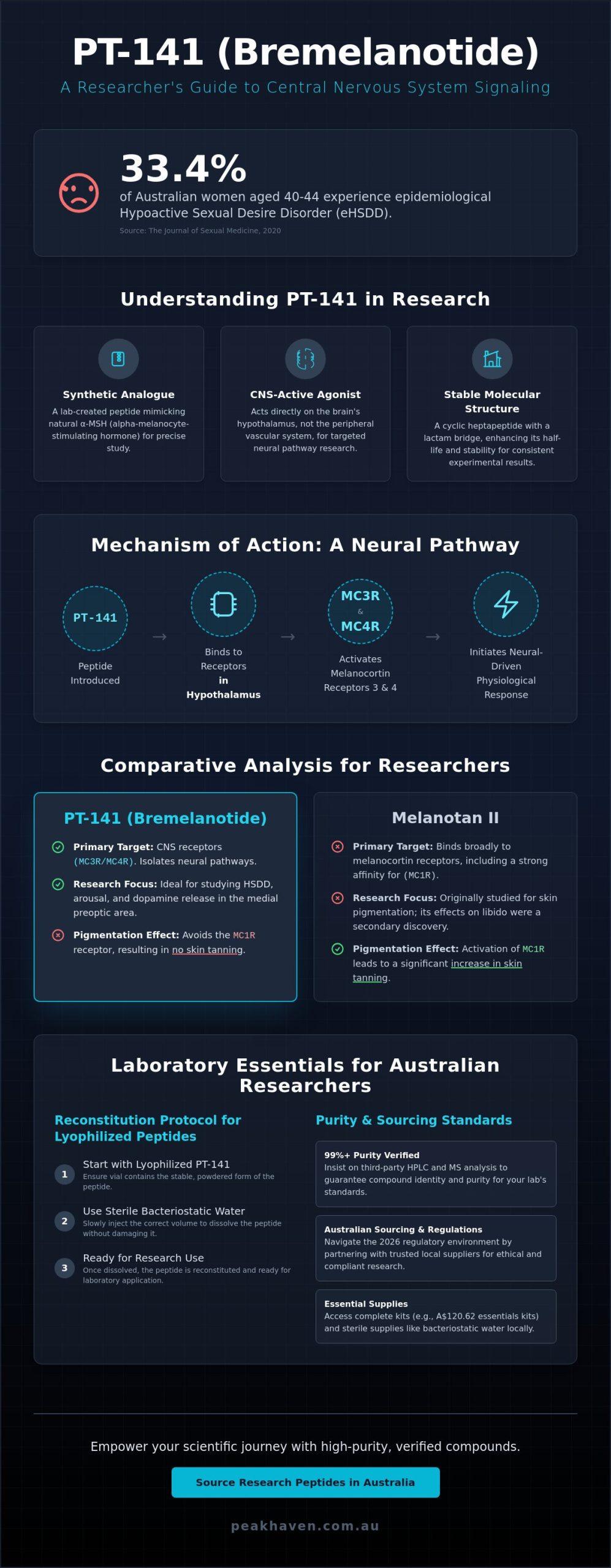
Choosing the right peptide for your study is a critical step in ensuring your results are both accurate and meaningful. While both compounds share a common ancestry, PT-141 is a metabolite of Melanotan II (MT2) that has been specifically modified for behavioral research. This structural shift allows scientists to isolate central nervous system responses without the broad physiological triggers associated with MT2. In many pt-141 research applications, the goal is to observe neural signaling without the interference of skin-darkening effects or intense nausea often reported with its predecessor.
The functional divergence between these two peptides lies in their receptor binding profiles. MT2 is a non-selective agonist that hits MC1R, MC3R, MC4R, and MC5R. In contrast, PT-141 shows a significantly lower affinity for the MC1R receptor. This means it doesn’t trigger the melanogenesis pathway, making it the preferred choice for behavioral studies where researchers want to avoid pigmentation as a confounding variable. Having a compound that does exactly what you need, without the extra noise, empowers you to reach your research peaks more effectively.
The primary reason researchers move away from MT2 in behavioral models is the induction of melanogenesis. If you’re tracking arousal or metabolic changes, the visible skin changes from Melanotan II research can complicate your observations. PT-141 focuses its energy on the MC3R and MC4R receptors in the brain. This allows for a cleaner data set, as you aren’t managing the side effects of a tanning agent while trying to measure neurochemical shifts. It’s about having choice and control over your experimental parameters.
In a controlled research environment, stability is your best ally. Reconstituted PT-141 generally maintains its integrity well when handled with care, though it’s sensitive to temperature fluctuations. Some research models have noted temporary blood pressure increases, which is a key factor to monitor during your studies. This data helps refine future pt-141 research applications by establishing clearer safety margins. To minimize variables, it’s vital to source high-purity HPLC tested peptides Australia. Ensuring your compounds are third-party verified protects your journey toward discovery and keeps your laboratory results consistent and reliable. You can find the high-purity compounds you need to support your goals by visiting Peak Haven today.
Proper handling is the foundation of any successful scientific journey. When planning your pt-141 research applications, the physical integrity of the compound is just as important as the hypothesis itself. PT-141 usually arrives as a lyophilized (freeze-dried) powder in 10mg vials, a format designed to ensure maximum stability during transit across the Australian climate. To maintain this stability, you should store the vials in a cool, dark environment, ideally between 2 and 8 degrees Celsius, to protect the delicate peptide bonds from light sensitivity and thermal degradation.
The transition from a powder to a liquid solution is a critical step that requires a steady hand. Achieving a sterile environment is paramount, which is why the role of Bacteriostatic Water cannot be overstated. This diluent contains 0.9% benzyl alcohol, which acts as a preservative to inhibit the growth of bacteria. Using standard sterile water might compromise your study if the solution isn’t used immediately, but bacteriostatic water allows for multiple draws over a period of up to 28 days when refrigerated properly.
Calculating the right concentration is your first task. For a 10mg vial, adding 1ml of diluent results in a concentration of 1mg per 0.1ml, while 2ml of diluent provides 0.5mg per 0.1ml. You should aim the stream of water against the glass wall of the vial rather than directly onto the powder. This prevents the peptide from foaming. Instead of shaking the vial, gently swirl it until the solution is clear and free of particles. For a deeper dive into these techniques, you can refer to our Bacteriostatic Water guide for detailed handling steps.
In the world of peer-reviewed science, third-party verification is a non-negotiable standard. You need to know that your compound is at least 99% pure to ensure your data isn’t skewed by contaminants or incorrect peptide sequences. High-Performance Liquid Chromatography (HPLC) and Mass Spectrometry (MS) testing provide the chemical “fingerprint” of the batch. Maintaining these standards ensures that your pt-141 research applications yield data that is both credible and reproducible.
Peak Haven acts as a dedicated ally in your procurement process. We understand the stress of sourcing high-purity compounds in the Australian market, so we prioritize security and transparency. By providing Australia-wide express shipping, we ensure your laboratory receives its supplies quickly and in optimal condition. We’re here to support your goals, offering a reliable bridge between your research needs and the high-quality resources required to achieve your highest potential in the lab.
You’ve seen how PT-141 serves as a precise tool for isolating central nervous system responses from peripheral variables. By targeting the MC4R pathway, your studies move beyond the confounding factors of pigmentation and vascular changes. Expanding your knowledge of pt-141 research applications allows you to lead the way in understanding neurochemical motivation and energy homeostasis in 2026. Maintaining the integrity of your results depends on the quality of your laboratory handling and the purity of your compounds. Every step you take, from careful reconstitution to verifying batches through HPLC testing, builds a foundation for credible data.
We’re here to be your dedicated partner in this scientific journey. You can explore our range of high-purity research peptides at Peak Haven, where we provide independent third-party HPLC testing for every batch and secure, Australia-wide express shipping from local facilities. We offer professional laboratory supplies that support the highest standards of scientific and clinical studies. Your commitment to excellence drives the progress of Australian science, and we’re honored to support your path toward new and empowering discoveries.
PT-141 acts as a non-selective agonist of melanocortin receptors, primarily targeting MC3R and MC4R in the central nervous system. Unlike traditional treatments that focus on the vascular system, it triggers neural pathways in the hypothalamus to modulate arousal. This specific action makes it a valuable tool for investigating behavioral responses and neural signaling in controlled laboratory settings.
PT-141 is a metabolite of Melanotan II that lacks a high affinity for the MC1R receptor, which is the primary driver of skin pigmentation. While Melanotan II is often studied for its tanning effects, PT-141 is preferred for behavioral research because it isolates central nervous system activity. This structural difference allows you to study arousal without the confounding variable of melanogenesis.
Yes, PT-141 is legal to purchase and use in Australia strictly for laboratory research and experimental purposes. It’s classified as a Schedule 4 substance, meaning it requires a prescription for therapeutic use, but it remains available for scientific inquiry. You should always ensure your sourcing and handling protocols align with your institutional ethics and the 2026 regulatory guidelines for non-clinical research.
You should store lyophilized PT-141 powder in a refrigerator between 2 and 8 degrees Celsius for short-term use, or in a freezer at -20 degrees Celsius for long-term stability. Once you’ve reconstituted the peptide, keep it refrigerated and away from direct light to prevent degradation. These steps ensure the integrity of your pt-141 research applications and maintain the quality of your data over the course of your study.
Bacteriostatic water contains 0.9% benzyl alcohol, which acts as a preservative to inhibit the growth of bacteria in your solution. Using simple sterile water for reconstitution can lead to contamination if the vial is used for multiple draws over several days. Bacteriostatic water provides a safer environment for your peptides, allowing you to maintain sterility for up to 28 days during your laboratory journey.
PT-141 is generally not suitable for pigmentation or tanning research because it has a very low affinity for the MC1R receptor. If your laboratory goals involve studying melanogenesis, Melanotan II is the more appropriate compound for those specific pathways. PT-141 is intentionally designed to bypass the skin’s tanning response, focusing instead on the behavioral signals and neurochemical pathways within the brain’s hypothalamus.

The products discussed in this article are intended strictly for laboratory and research purposes only. They are not intended for human consumption, therapeutic use, or as dietary supplements. Nothing in this article should be interpreted as medical advice, a diagnosis, or a recommendation for treatment. Always consult a qualified healthcare professional for any medical concerns.
Peak Haven supplies research-grade peptides exclusively for scientific and clinical research use. All products undergo independent third-party HPLC testing to verify purity and composition. By purchasing from Peak Haven, you confirm that products will be used solely for legitimate research purposes in accordance with all applicable Australian laws and regulations.
The information presented in this article is based on published scientific literature and is provided for educational purposes only. Peak Haven makes no claims regarding the efficacy or safety of any compound for human use. Individual research results may vary. References to studies or research findings do not constitute endorsement of any specific application.
 by
by