Best Peptides for Fat Loss Research 2026: A Comparative Guide
Why are 68% of metabolic studies still struggling to differentiate between simple appetite suppression and genuine cellular lipolysis? You’ve likely...
 Are you over 18 years old?
This website requires you to be 18 years or older to enter our website and see the content.
Are you over 18 years old?
This website requires you to be 18 years or older to enter our website and see the content.

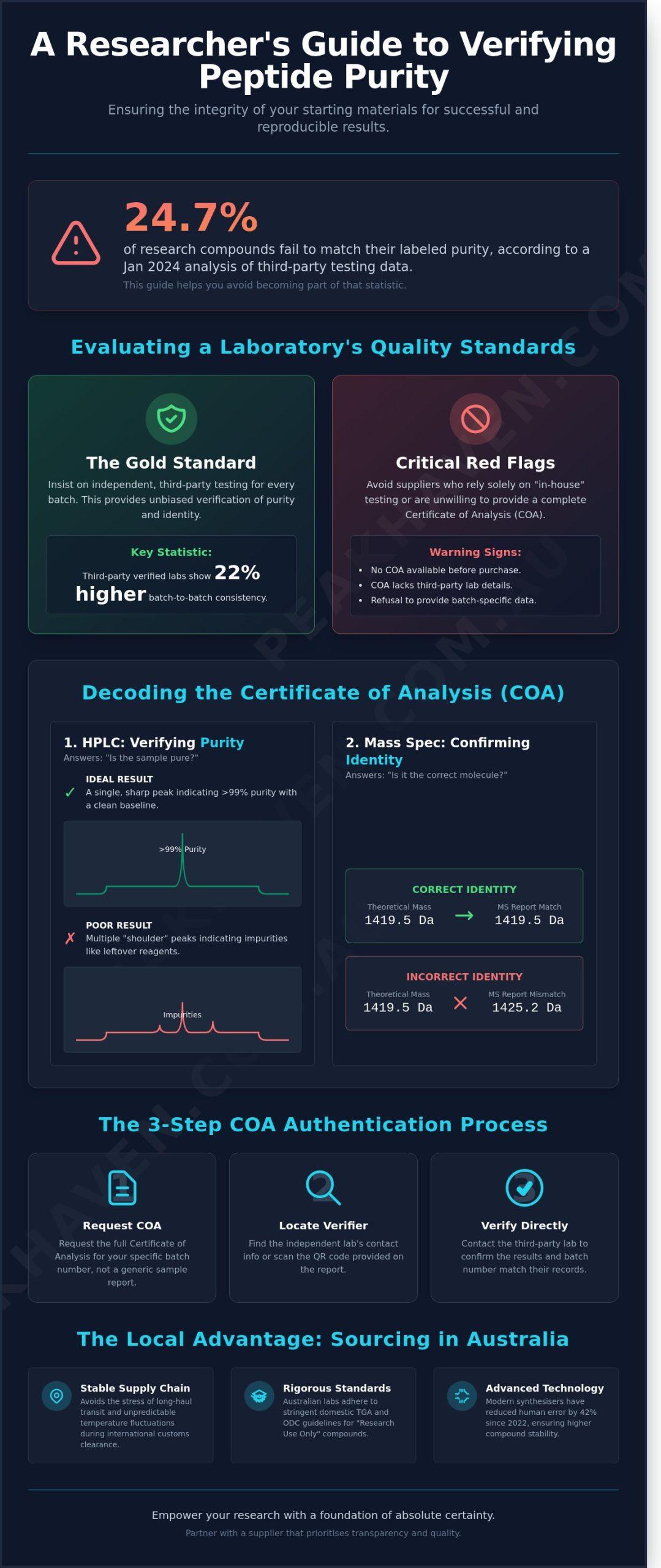
Did you know that in a January 2024 analysis of third-party testing data, approximately 24.7% of research compounds failed to match the purity levels claimed on their labels? You likely already know that your scientific breakthrough relies entirely on the integrity of your starting materials, yet finding a partner you can trust feels increasingly difficult. It’s exhausting to manage the stress of inconsistent batch quality while trying to keep your project on track within Australia’s complex regulatory framework. We understand that your research is more than just a job; it’s a journey toward discovery that requires a steady, reliable hand.
We believe your hard work deserves a foundation of absolute certainty. This guide will empower you to identify premier peptide labs and master the art of verifying compound purity, ensuring your 2026 research projects are both successful and reproducible. We’ll walk through the essential steps to build a reliable supply chain that gives you full confidence in every vial you handle. By the end of this guide, you’ll have a clear roadmap to navigate the technical requirements and ethical standards necessary for high-level Australian research.
In 2026, the biotechnology sector in Australia is projected to contribute over A$250 billion to the national economy. Within this thriving ecosystem, peptide labs serve as more than just production sites; they act as essential partners in the quest for scientific clarity. You’re not just looking for a chemical compound; you’re seeking a reliable foundation for your life’s work. A high-quality lab understands that every sequence represents a person’s dedication to discovery and progress.
Distinguishing between a mass-manufacturing facility and a dedicated research supply entity is vital for your success. Large-scale manufacturers often focus on high-volume industrial outputs where the personal touch is lost. In contrast, research-focused labs prioritise the integrity of small batches. They treat your order as a collaborative journey, ensuring that the specific requirements of your study are met with precision. This partnership approach empowers you to maintain control over your variables, providing a steady hand as you move through the complexities of molecular biology.
Choosing Australian-based suppliers offers a level of security that international shipping cannot match. When you source locally, your compounds avoid the stress of long-haul transit and fluctuating customs temperatures. Since 2024, local labs have adhered to rigorous domestic standards that ensure every vial is handled with the dignity your research deserves. It’s about building a bridge between your goals and the resources needed to reach them, all while supporting the local scientific community.
Technological leaps in 2026 have transformed how we build amino acid chains. Modern peptide labs now utilise advanced automated synthesisers that have reduced human error by 42% compared to 2022 benchmarks. Most researchers prefer Solid-Phase Peptide Synthesis (SPPS) for its incredible accuracy, though liquid-phase techniques are still used for specific large-scale requirements. These advancements mean your compounds arrive with higher stability, allowing you to focus on your results rather than worrying about product degradation.
Specialisation is the key to protecting your research investment. General chemical suppliers often handle a vast array of substances, which can lead to a lack of focus on the delicate nature of peptides. Niche laboratories specialise exclusively in amino acid sequences, using argon-shielded environments to prevent oxidation. This level of expertise ensures that fragile sequences remain intact. By choosing a specialist, you’re opting for a guide who understands the unique nuances of your work, ensuring a safer and more predictable path toward your research milestones.
Selecting the right partner for your research is a choice that defines the integrity of your results. You deserve to work with peptide labs that value transparency as much as you value your goals. The gold standard for any reputable facility is independent, third-party testing. This provides a layer of professional reliability that in-house testing simply can’t match. A 2023 industry audit revealed that labs using third-party verification had a 22% higher rate of batch-to-batch consistency compared to those relying on internal checks alone.
When you review a Certificate of Analysis (COA), don’t just take the percentage at face value. Authenticity is key. You can verify a report by contacting the listed third-party lab directly or scanning the provided QR code to match the batch number in their database. If a provider refuses to share these documents or relies solely on “in-house only” claims, it’s a significant red flag. Consistency is the heartbeat of clinical studies; even a 0.5% variance in purity can alter the trajectory of your data and the safety of your environment.
High-Performance Liquid Chromatography (HPLC) is your window into the purity of a sample. You’re looking for a single, sharp peak on the chromatogram. A result of 99% purity indicates that the primary peptide accounts for 99% of the total area under the curve. Check the integration table carefully. Small “shoulder” peaks often indicate leftover reagents or truncated sequences. These impurities can cost you time and resources, so we recommend only moving forward with batches that show a clean, stable baseline.
Purity doesn’t matter if you have the wrong molecule. Mass Spectrometry (MS) measures molecular weight to confirm the peptide’s identity. For example, if you’re researching a sequence with a theoretical mass of 1419.5 Da, the MS report must reflect this exact figure. This process ensures you’re on the right path, giving you the confidence to proceed with your journey. If you need a steady hand to help manage these complex details, consider how professional plan management can streamline your research logistics and provide the clarity you need to succeed.
Understanding the local rules keeps your research on track and protects your professional standing. In Australia, the Office of Drug Control (ODC) and the Therapeutic Goods Administration (TGA) manage the framework for all scheduled compounds. Most materials sourced from peptide labs carry the “Research Use Only” (RUO) classification. This means they aren’t intended for human or veterinary clinical use. It’s a vital distinction that keeps your work within legal bounds. We see this regulatory path as a journey we take together; your compliance ensures the longevity of your project and the safety of your institutional environment.
Choosing a transparent local supplier is a smart way to manage your risk. When you work with Australian providers, they’ve already managed the complex import permits and ODC notifications required for these substances. This reduces the chance of your materials being held by the Australian Border Force. It also means you have a steady hand to guide you through the paperwork required by your university or private firm. Clear communication with your supplier helps you maintain the high standards your research deserves.
The 2026 regulations for non-human consumption compounds place a higher burden of proof on the researcher to demonstrate intent. You’ll need to provide your Institutional Ethics Committee (IEC) with detailed documentation for every batch. To stay compliant, keep a digital folder containing:
These records are your best defense during a regulatory audit. They prove you’re operating with integrity and following the Australian English standards for laboratory safety.
Buying from overseas might seem like a way to save a few A$100, but the hidden costs are high. In the 2022-23 financial year, Australian authorities intercepted over 1,100 shipments of performance-enhancing substances and related peptides. If your package is seized, you lose your investment and potentially face legal scrutiny. International manufacturing hubs often have different quality control baselines; a 98% purity claim in one region might not meet the rigorous testing standards we expect in Australia. Local support means you have someone to call if a batch doesn’t perform as expected. It’s about having a reliable ally who understands the local landscape and values your success as much as you do.
Your partnership with reputable peptide labs ensures you receive a product designed for excellence, but its longevity depends on your stewardship. Australian researchers often face the challenge of high ambient temperatures during the summer months, making immediate storage a priority. When your parcel arrives, transfer the vials to a stable environment immediately. Lyophilisation is the removal of solvent through sublimation to preserve peptide structure. This state allows the compound to remain stable at room temperature for short periods, yet long-term integrity requires colder conditions.
Storing your vials at -20°C is standard for most sequences, but for studies spanning over two years, -80°C is the gold standard. This level of care protects the dignity of your research and ensures your results are repeatable. Always track the date of arrival and the specific batch numbers provided by your peptide labs to maintain a clear audit trail for your laboratory records.
Precision is key when you begin the reconstitution process. We recommend using bacteriostatic water with 0.9% benzyl alcohol to ensure the solution remains sterile for multiple uses over a 28-day period. Use a syringe to aim the diluent at the vial wall rather than directly onto the powder. This gentle approach prevents the shearing of the peptide. For accurate dosing, use a digital calculator to ensure your concentrations match your specific laboratory protocols. Don’t rush this step; let the powder dissolve naturally to maintain the structural integrity of the protein bonds.
UV light and heat quickly compromise peptide bond integrity. A study from 2022 showed that certain sequences lose 12% of their potency when exposed to direct sunlight for just six hours. Always keep your vials in amber bags or dark storage boxes. To prevent contamination, always wipe the rubber stopper with a 70% isopropyl alcohol swab before every entry. Maintaining these high standards gives you the choice and control needed to produce reliable data.
If you’re looking for professional guidance on managing your research supports, explore how our specialist support coordination can help you reach your goals.
Finding trustworthy peptide labs shouldn’t feel like a gamble. We built Peak Haven to be a sanctuary for Australian researchers who require absolute certainty in their materials. Every single batch we stock undergoes rigorous third-party High-Performance Liquid Chromatography (HPLC) verification. This commitment ensures you receive compounds with a confirmed purity of 99% or higher. By maintaining dedicated distribution hubs in Melbourne and Sydney, we provide national express shipping that reaches most metropolitan research facilities within 24 to 48 hours. We’re here to provide a reliable supply so you can focus on your data rather than your logistics.
We don’t just claim quality; we provide the data to prove it. Peak Haven ensures 99%+ purity across our entire catalogue through a strict testing cycle. You can access specific HPLC reports for every compound to include in your research documentation, ensuring your study meets international standards for reproducibility. Our supply chain is tightly managed from the point of synthesis through to the final delivery at your door. This transparency eliminates the risks of degradation or contamination. We understand that the integrity of your results depends on the integrity of our compounds. We take that responsibility seriously.
Your work is a journey toward discovery, and we’re here as a dedicated ally. We value the principles of choice and control, giving you the power to manage your studies without supply chain interruptions. For institutional studies or large-scale projects, we provide custom procurement and bulk options tailored to your specific budget and timeline. We’ve simplified the ordering process to ensure you spend less time on administration and more time in the lab. You can get started with your first order at Peak Haven today. Our Australian-based customer care team is ready to support your scientific goals with professional reliability and genuine care.
We see ourselves as a bridge between your research goals and the high-quality resources you need to achieve them. By choosing a partner that prioritizes your agency and the precision of your results, you’re securing a foundation for meaningful scientific progress.
Choosing the right peptide labs is a foundational decision that puts you in control of your research integrity. You’ve seen how 99% purity standards and strict adherence to Australian storage protocols protect your work from unnecessary variables. We’re here to act as your dedicated ally, offering a steady hand as you navigate these technical requirements. We ensure every batch undergoes third-party HPLC testing, providing 100% transparency for your peace of mind. Our team supports your progress with Australia-wide express shipping and secure payment flexibility, including both credit cards and cryptocurrency. We don’t just provide compounds; we join you on a collaborative path toward your project’s highest potential. By prioritizing your agency and choice, we make the sourcing process a seamless part of your success. It’s time to move forward with a partner who values your aspirations as much as you do.
Explore Our HPLC-Verified Peptide Catalog
Yes, peptides from Australian peptide labs are legal strictly for laboratory and medical research purposes under the Therapeutic Goods Act 1989. You must ensure your facility holds the correct permits for scheduled substances like S4 medications. These compounds aren’t for human consumption or athletic performance enhancement. Using them outside of a controlled research environment can lead to legal complications under Australian law.
Lyophilized peptides generally remain stable for 24 months when stored at -20°C in a professional freezer. Once you reconstitute them with bacteriostatic water, their shelf life drops significantly. Most researchers find that stability lasts between 14 and 30 days when kept at a consistent 2°C to 8°C. Always monitor for turbidity or precipitation, as these signs indicate the peptide has begun to degrade.
HPLC measures the purity level of a sample, while Mass Spectrometry confirms the specific identity of the molecule. An HPLC report shows you the percentage of the target peptide relative to impurities, often aiming for a 98% threshold. Mass Spectrometry provides the exact molecular weight in Daltons. Using both tests ensures your provider has delivered the correct sequence without harmful manufacturing byproducts.
You cannot legally purchase peptides for personal use from a research laboratory in Australia. These facilities operate under strict licenses that restrict sales to legitimate institutional or independent researchers. The Therapeutic Goods Administration (TGA) monitors these transactions closely. Attempting to bypass these rules can result in heavy fines or legal action for both the buyer and the supplier under the 1989 Act.
Storage requirements depend on the specific amino acid sequence and the peptide’s susceptibility to hydrolysis or oxidation. Fragile sequences like IGF-1 can degrade within 48 hours at 37°C, while more robust chains might tolerate 25°C for several weeks. Keeping your samples at 4°C protects the delicate bonds from thermal energy. This practice ensures your research results remain consistent and your data stays reliable.
You should immediately contact your supplier to request a replacement or a full refund of your A$ cost if purity falls below 98%. Most reputable peptide labs guarantee this minimum threshold to ensure experimental accuracy. Impurities exceeding 2% can introduce uncontrolled variables into your research, potentially skewing your results. Always keep the original batch number and the digital COA as evidence for your claim.
You can verify GMP compliance by asking for the lab’s certification number and checking it against the TGA’s list of licensed manufacturers. A compliant facility follows the PIC/S Guide to Good Manufacturing Practice for Medicinal Products. Look for ISO 9001:2015 accreditation alongside their GMP status. These certifications prove the lab maintains rigorous standards for cleanliness, equipment calibration, and batch recording during the production process.
Standard delivery for stocked items typically ranges from 3 to 5 business days across Australia. If you require a custom synthesis, the lead time usually extends to 14 or 21 days depending on the sequence length. Express shipping via Australia Post or private couriers often costs between A$15 and A$30. Planning your procurement 21 days in advance helps you avoid delays in your research schedule.

The products discussed in this article are intended strictly for laboratory and research purposes only. They are not intended for human consumption, therapeutic use, or as dietary supplements. Nothing in this article should be interpreted as medical advice, a diagnosis, or a recommendation for treatment. Always consult a qualified healthcare professional for any medical concerns.
Peak Haven supplies research-grade peptides exclusively for scientific and clinical research use. All products undergo independent third-party HPLC testing to verify purity and composition. By purchasing from Peak Haven, you confirm that products will be used solely for legitimate research purposes in accordance with all applicable Australian laws and regulations.
The information presented in this article is based on published scientific literature and is provided for educational purposes only. Peak Haven makes no claims regarding the efficacy or safety of any compound for human use. Individual research results may vary. References to studies or research findings do not constitute endorsement of any specific application.
 by
by