Best Peptides for Fat Loss Research 2026: A Comparative Guide
Why are 68% of metabolic studies still struggling to differentiate between simple appetite suppression and genuine cellular lipolysis? You’ve likely...
 Are you over 18 years old?
This website requires you to be 18 years or older to enter our website and see the content.
Are you over 18 years old?
This website requires you to be 18 years or older to enter our website and see the content.

Isolating the lipolytic properties of human growth hormone without triggering systemic growth or insulin resistance is the primary breakthrough for modern metabolic research. While full-length HGH impacts multiple cellular pathways, the frag 176-191 peptide function is specifically refined to target fat metabolism in laboratory settings. You might have noticed that many studies, including a 2004 clinical trial on the related AOD9604 compound, focus on this specific C-terminal fragment because it avoids the unwanted IGF-1 elevations seen with the parent molecule.
We understand that distinguishing between Frag 176-191 and its derivatives can be confusing, especially when your study requires high-purity, HPLC-verified materials. It’s often difficult to source research peptides in Australia that offer the transparency your work deserves. This guide provides a comprehensive analysis of the biochemical mechanisms driving Frag 176-191 research. You’ll gain a clear understanding of its non-systemic effects, precise reconstitution protocols, and how to secure pharmaceutical grade peptides with third-party verification. We’ll explore how this peptide serves as a steady hand for researchers pursuing metabolic breakthroughs while ensuring your laboratory has access to reliable Australian-based shipping.
Understanding the frag 176-191 peptide function starts with its unique molecular map. This synthetic peptide is a 16-amino acid chain that replicates the C-terminal end of the 191-amino acid human growth hormone (hGH) molecule. While the parent hormone is responsible for a vast array of physiological processes, researchers isolated this specific “tail” because it appears to govern the molecule’s fat-modulating properties without affecting growth. By focusing on this narrow segment, laboratory studies can observe metabolic changes in isolation, providing a clearer picture of cellular energy expenditure.
To help visualize how these modified growth hormone fragments compare in a research context, this brief breakdown is useful:
The sequence consists of amino acids 176 through 191: Tyr-Leu-Arg-Ile-Val-Gln-Cys-Arg-Ser-Val-Glu-Gly-Ser-Cys-Gly-Phe. This specific arrangement is what gives HGH Fragment 176-191 its lipolytic profile. It’s often compared to AOD-9604, which is essentially the same fragment but with an additional tyrosine residue to improve stability. In laboratory settings, maintaining this stability is vital. When you’re conducting in vitro studies, the peptide’s integrity in aqueous solutions depends heavily on the quality of your solvents. Many Australian researchers rely on Bacteriostatic Water to ensure these delicate chains don’t degrade prematurely during the observation phase.
The primary reason for isolating this fragment is to remove the growth-promoting domains found in full-length somatotropin. While the parent hormone has a molecular weight of approximately 22 kDa, Frag 176-191 is a much smaller 1.8 kDa. This size difference isn’t just about scale; it’s about receptor binding. The fragment lacks the regions that trigger IGF-1 secretion, which is a key requirement for studies focusing solely on adipose tissue. A critical feature of its architecture is the disulphide bridge between the cysteine residues. This bridge maintains the peptide’s secondary structure, allowing it to interact with metabolic pathways while remaining “silent” regarding systemic growth. Ensuring you’re working with pharmaceutical grade peptides that have undergone third-party HPLC testing is the only way to confirm this specific disulphide bond is intact and the sequence is pure. At Peak Haven, we prioritise this level of transparency, providing Australian researchers with the reliable data they need for reproducible results.
The primary appeal of the frag 176-191 peptide function lies in its dual action within metabolic research; it simultaneously encourages the breakdown of existing lipids while preventing the formation of new fatty acids. Unlike full-length growth hormone, which has broad systemic effects, this fragment acts as a precision tool in laboratory models. Researchers have observed that it specifically targets adipose tissue, triggering a significant increase in lipolytic activity. This makes it an invaluable compound for studies aimed at understanding weight regulation and metabolic efficiency without the interference of growth-factor upregulation.
A critical pathway for this activity involves the beta-3 adrenergic receptors. These receptors are heavily expressed in adipose tissue and play a major role in thermogenesis and lipid oxidation. Published research on fat oxidation demonstrates that Frag 176-191 mimics the way natural growth hormone interacts with these receptors, but with a higher degree of specificity. In rodent-based studies, this interaction led to a measurable reduction in fat mass and an increase in energy expenditure, with effects often recorded at dosages of 500?g per study subject.
At the cellular level, the peptide triggers hormone-sensitive lipase (HSL). This enzyme is responsible for the hydrolysis of stored triglycerides into free fatty acids and glycerol. By stimulating HSL, the peptide facilitates the mobilisation of energy stores within isolated research cells. Laboratory observations show that this process occurs without the “rebound” effect of lipogenesis, effectively blocking the pathways that allow cells to synthesise new fat. For those designing complex trials, integrating this fragment into peptide stacks for research can provide a multi-faceted view of metabolic pathways.
One of the most significant findings in metabolic research is that Frag 176-191 does not appear to induce hyperglycaemia. Full-length HGH often causes a decrease in insulin sensitivity, but this fragment lacks the domains that compete for insulin receptors. This distinction is vital for diabetic laboratory models or metabolic syndrome research. Because it doesn’t impact blood glucose levels, researchers can study lipid metabolism in isolation from the complex insulin-growth factor axis. If you’re looking to buy research peptides in Australia for these sensitive studies, ensuring you have HPLC-tested compounds is the best way to maintain the integrity of your metabolic data. You can explore our full range of high-purity laboratory supplies at peakhaven.com.au to support your next project.
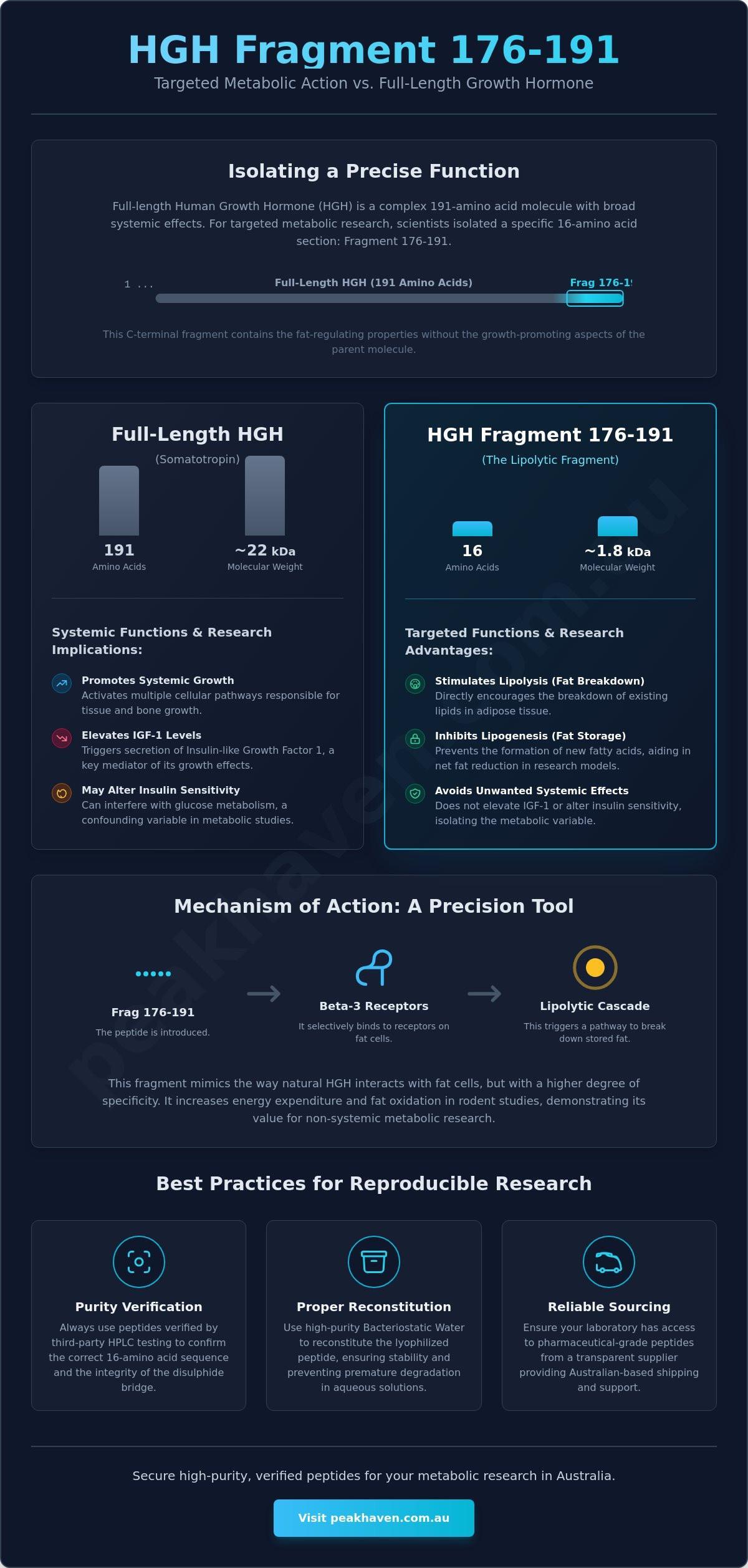
Choosing the right tool for metabolic research requires a clear understanding of how hormonal fragments differ from their parent molecules. While full-length human growth hormone (hGH) is highly pleiotropic, meaning it affects multiple tissue types and biological pathways, the frag 176-191 peptide function is remarkably narrow. In laboratory models, hGH promotes cellular proliferation, bone growth, and protein synthesis. These systemic effects are often undesirable when the research goal is strictly limited to lipid metabolism. By using the isolated fragment, researchers can observe lipolytic activity without the confounding variables of systemic growth or the risk of off-target tissue development.
The most significant gap in current literature is often the failure to emphasize the lack of IGF-1 upregulation. When full-length hGH or growth hormone releasing hormones like Tesamorelin are introduced to a subject, they trigger the liver to secrete Insulin-like Growth Factor 1. This rise in IGF-1 is responsible for many of the growth-related outcomes but also contributes to side effects like water retention and joint discomfort. Frag 176-191 doesn’t share this mechanism. It lacks the binding domains required to stimulate the IGF-1 axis, making it a “cleaner” instrument for studying fat oxidation in isolation. This specificity is why many laboratories prefer it over broader secretagogues when focusing on metabolic regulation.
Data from several longitudinal studies, including those assessing human safety and tolerability of similar fragments, show a distinct lack of the adverse effects typically linked to hGH. Research subjects don’t exhibit the carpal tunnel symptoms or significant oedema often seen with high-dose somatotropin. This profile allows for longer observation periods in animal models without the health complications that could compromise the study’s integrity. It’s a steady choice for researchers who need to maintain a stable environment for their subjects while monitoring fat breakdown.
Researchers must decide between studying total cellular growth or isolated energy expenditure. If your laboratory’s objective is muscle hypertrophy or tissue repair, full-length peptides or blends are more appropriate. However, if the focus is on obesity models or lipid-clearing pathways, Frag 176-191 is the superior choice. Its reduced cross-reactivity with the insulin receptor and other hormonal axes ensures that metabolic data remains untainted by growth-factor interference. For a deeper dive into how these compounds fit into broader study designs, you can refer to our Peptides Australia: The Ultimate 2026 Guide.
Reliability in these comparisons depends entirely on the purity of your compounds. When you buy HPLC tested peptides in Australia from Peak Haven, you’re ensuring that your comparative analysis is based on high-purity materials that meet strict laboratory standards.
Precision is the foundation of any successful scientific study. When investigating the frag 176-191 peptide function, the accuracy of your results depends entirely on the stability and purity of the compound. Many international suppliers fail to provide the rigorous documentation required for peer-reviewed research, which can lead to baseline inconsistencies. By adhering to strict laboratory protocols, you ensure that your metabolic data reflects the peptide’s true biochemical potential. We’re here to act as your steady partner, providing the high-purity tools you need for a successful research journey.
Preserving the delicate 16-amino acid chain requires a gentle touch. Mechanical stress during reconstitution can shear the peptide bonds, rendering the sample useless for precise observations. You should always follow these steps to maintain molecular integrity:
For long-term storage, lyophilised vials should be kept in a laboratory freezer at -20°C. Once you’ve reconstituted the peptide, it’s best to store it in a refrigerator between 2°C and 8°C. Studies suggest that even under these conditions, reconstituted fragments should be used within 14 to 21 days to prevent degradation and ensure the frag 176-191 peptide function remains consistent throughout your study.
Reliability in the Australian research community is often hampered by long lead times and customs hurdles. Sourcing research peptides in Australia through local suppliers like Peak Haven eliminates the risk of temperature fluctuations during international transit. We prioritise transparency by ensuring every batch undergoes third-party HPLC testing. High-Performance Liquid Chromatography (HPLC) is non-negotiable for serious researchers. It’s the only way to verify that your compound is free from the contaminants that could skew metabolic research or affect insulin receptor data.
We understand that your work is a collaborative step toward a more fulfilling understanding of metabolic science. By providing pharmaceutical grade peptides with verified purity, we offer a steady hand in your procurement process. Choosing Australian-based shipping means your supplies arrive quickly, maintaining the cold chain and protecting the integrity of your work. You can explore our full range of high-purity laboratory supplies and find the right tools for your project at peakhaven.com.au.
Selecting the right biochemical tools is the first step toward achieving reproducible, high-quality data in your laboratory. We’ve explored how the unique frag 176-191 peptide function allows you to isolate lipolytic activity from systemic growth factors, providing a focused lens for metabolic studies. By bypassing the IGF-1 axis, this fragment offers a level of specificity that full-length hormones can’t match. It’s a choice that empowers researchers to pursue complex metabolic questions with greater clarity and fewer off-target variables.
Your journey toward discovery deserves the support of a reliable partner who understands the Australian research landscape. We provide third-party HPLC purity verification for every batch, ensuring your work is built on a foundation of integrity. With fast Australia-wide express shipping, you won’t have to worry about the delays or temperature risks associated with international transit. Please keep in mind that all our compounds are strictly for laboratory research use and aren’t intended for human consumption.
We’re here to help you reach the peak of your research potential with confidence. Explore our HPLC-tested Frag 176-191 and research range at Peak Haven today and take the next collaborative step in your scientific journey.
No, these two compounds aren’t identical. Frag 176-191 is the original 16-amino acid C-terminal fragment of the human growth hormone molecule. AOD-9604 is a modified version that includes an additional tyrosine residue at the N-terminal end to enhance its metabolic stability. While they share similar lipolytic research goals, scientists often choose between them based on the specific stability requirements of their in vitro environments.
Frag 176-191 does not increase IGF-1 levels in research models. This is a defining characteristic of the frag 176-191 peptide function; it isolates the fat-burning mechanism of growth hormone without triggering the insulin-like growth factor axis. This lack of IGF-1 upregulation is verified by studies showing it doesn’t cause the cellular proliferation or water retention associated with full-length somatotropin, making it a cleaner tool for metabolic observation.
Lyophilised vials should be stored at -20°C for long-term stability of up to 24 months. Once you’ve reconstituted the peptide, it’s essential to keep it in a refrigerator at 2°C to 8°C. At these temperatures, the peptide remains stable for approximately 14 to 21 days. Protecting the vial from light and avoiding repeated freeze-thaw cycles helps preserve the delicate molecular structure for accurate and reproducible research data.
Bacteriostatic water is the recommended liquid for reconstituting Frag 176-191 in a laboratory setting. The 0.9% benzyl alcohol in bacteriostatic water inhibits bacterial growth, which is vital for multi-use vials during a 14-day study period. Sterile saline is an alternative for single-use applications, but it lacks the antimicrobial properties needed for extended observation. Always ensure the liquid is introduced slowly to avoid shearing the peptide chains.
No, Frag 176-191 cannot be used for human consumption in Australia. Peak Haven provides these compounds strictly for laboratory research and scientific studies. It’s important to remember that this peptide is not TGA-approved for therapeutic use and is classified as a banned substance by WADA under Section S2. All research must be conducted within a controlled laboratory environment following Australian regulatory guidelines and safety standards.
The gold standard for high-purity Frag 176-191 is a third-party HPLC test report showing a purity level of 98% or higher. A clear, uniform lyophilised cake in the vial is another physical indicator of quality processing. When you source pharmaceutical grade peptides from Peak Haven, we provide these verification reports to ensure your frag 176-191 peptide function research meets the rigorous standards required for peer-reviewed Australian publications.

The products discussed in this article are intended strictly for laboratory and research purposes only. They are not intended for human consumption, therapeutic use, or as dietary supplements. Nothing in this article should be interpreted as medical advice, a diagnosis, or a recommendation for treatment. Always consult a qualified healthcare professional for any medical concerns.
Peak Haven supplies research-grade peptides exclusively for scientific and clinical research use. All products undergo independent third-party HPLC testing to verify purity and composition. By purchasing from Peak Haven, you confirm that products will be used solely for legitimate research purposes in accordance with all applicable Australian laws and regulations.
The information presented in this article is based on published scientific literature and is provided for educational purposes only. Peak Haven makes no claims regarding the efficacy or safety of any compound for human use. Individual research results may vary. References to studies or research findings do not constitute endorsement of any specific application.
 by
by